EXPERT GUIDE
Apostille vs Notarization:
What's the Difference?
No, an apostille and a notarization are not the same thing.
A notarization verifies the identity of the signer. An apostille authenticates a document for use in another country.
FOUNDATIONAL DEFINITIONS
Two Different Purposes
What Is a Notarization?
A notarization serves as an official fraud deterrent. It verifies the identity of the person signing a document, ensuring they are acting willingly and understand the contents. A commissioned notary public acts as an impartial witness to the transaction.
- Primary goal: Identity verification and fraud prevention
- Role: Impartial witnessing of signatures
- Common uses: Powers of Attorney and Affidavits
- Essential for: Real Estate and Estate Planning documents
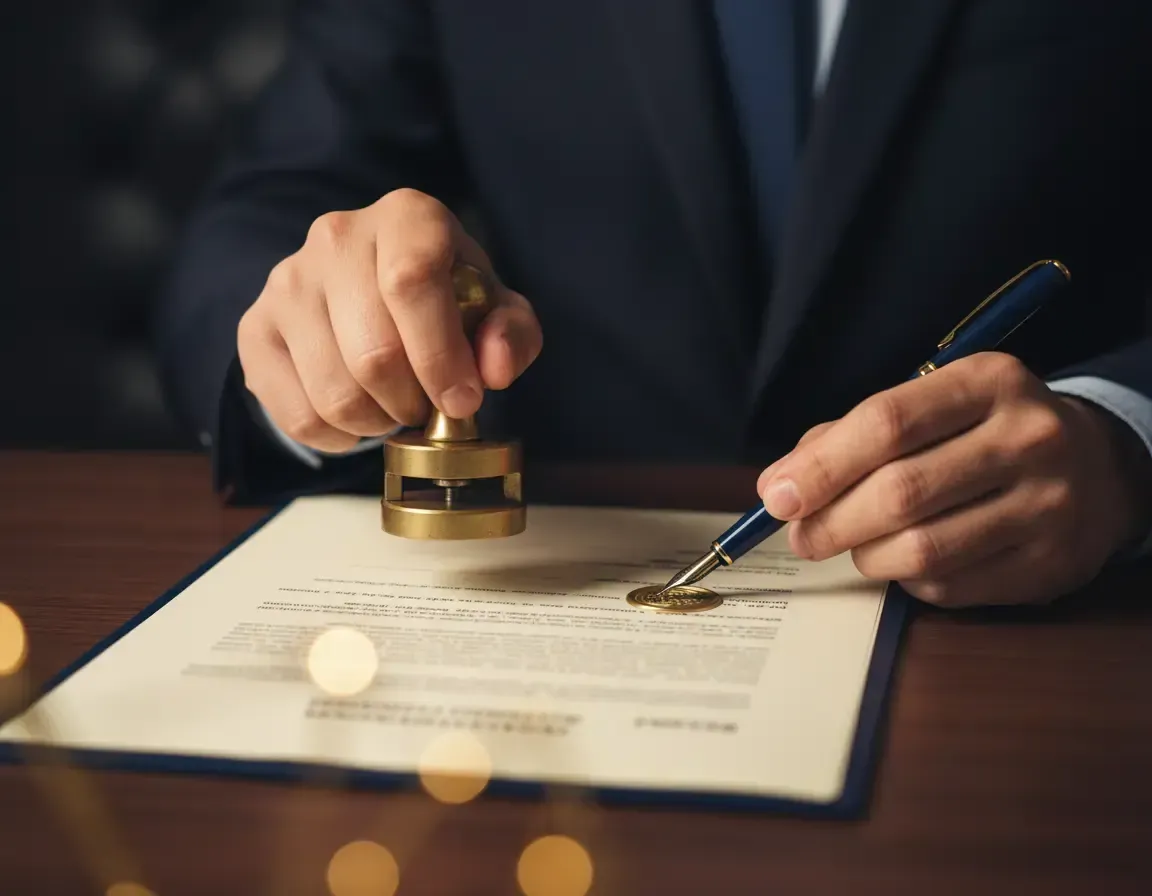

What Is an Apostille?
An apostille is a specialized certificate attached to your original document, verifying its authenticity for international use. Regulated by the Hague Apostille Convention, it ensures that foreign governments legally recognize your paperwork.
- Primary goal: International document authentication
- Regulation: Issued under the Hague Convention
- Common uses: Birth, marriage, and death certificates
- Essential for: Corporate documents used across borders
Apostille vs Notarization
Comparison
| Feature | Notarization | Apostille |
|---|---|---|
| Purpose | Verifies identity and willingness of the signer | Authenticates the signature and seal of the public official |
| Who Issues It | Commissioned Notary Public | State Secretary of State or U.S. Dept. of State |
| Where It Is Used | Domestically (within the US) | Internationally (Hague Convention countries) |
| International Acceptance | Often rejected abroad without further authentication | Universally accepted in Hague Convention member states |
| Identity Verification | Required: Signer must be present and ID verified | Not Required: Authenticates the notary, not the signer |
| Processing Time | Immediate (while present) | Varies (typically days to weeks depending on state) |
| Typical Documents | Affidavits, Deeds, Domestic Contracts, Wills | Birth Certificates, International POAs, Corporate Docs |
| Cost Considerations | Generally low, per-signature fee set by state law | Higher, includes state fees and processing charges |
DIAGNOSTIC GUIDE
Which Do You Need?
Select the scenario that best matches your situation to determine whether you need a notary, an apostille, or both.
Only Notarization
For documents that will be used exclusively within the United States. Verifies the identity of the signer and ensures willing execution.
- Domestic Real Estate
- Living Wills & Trusts
- Local Affidavits
Only Apostille
For government-issued vital records that need to be presented in a foreign country. These records are already certified by the state.
- Birth Certificates
- Marriage Certificates
- FBI Background Checks
Both Required
For privately drafted documents intended for overseas use. A notary must first verify the signature before the state can issue the apostille.
- Foreign Property Purchases
- Corporate Articles
- International Affidavits
Still unsure? Contact us for a free document evaluation.
QUICK REFERENCE
Common Documents Guide
Use this matrix to quickly identify whether your specific document type requires an Apostille for international use, the necessary prerequisites, and typical use cases.
| Document Type | Apostille Commonly Required? | Typical Use Cases |
|---|---|---|
| Birth & Marriage Certificates | Yes Must be certified copies issued by State or County | Dual citizenship, international marriage, foreign visa applications. |
| Diplomas & Transcripts | Yes Must be notarized by the school registrar first | Studying abroad, international employment, foreign professional licensing. |
| Power of Attorney | Yes Requires standard notarization prior to Apostille | Buying or selling foreign property, legal representation abroad. |
| Corporate Documents (e.g., Articles of Incorporation) | Yes Must be certified by the Secretary of State | Opening foreign bank accounts, establishing international business branches. |
| Adoption Documents | Yes Must be court-certified documents | International adoption proceedings, establishing foreign residency for dependents. |
EXPERT PROTECTION
Avoid These Costly Mistakes
Navigating international document authentication is unforgiving. A single error can lead to instant rejections, delayed travel, and lost processing fees. Don't leave your important documents to chance, let our experts handle the precision work.
Guaranteed Precision
Every document is meticulously audited against Florida statutes and Hague requirements before processing, ensuring first-time approval.
Submitting Uncertified Documents
Only original, certified copies issued by the correct authority are eligible for Apostille. Photocopies or uncertified originals will be instantly rejected by the state.
Incorrect Notarizations
Documents must contain proper notarial certificates, correct jurats, and meet specific state statutory requirements. A simple notary stamp without the proper wording is invalid for international use.
Non-Hague Destination Countries
The Apostille process only applies to countries within the Hague Convention. Documents bound for non-member nations require a much longer, multi-step Embassy Legalization process.
Missing or Improper Signatures
Every required signature must be present, legible, and match the printed name on the document exactly. Missing witnesses or mismatched names guarantee a rejection.
Outdated Vital Records
Many foreign governments require vital records (like birth or marriage certificates) to be recently issued—often within the last 3 to 6 months. Older copies, even if officially certified, are frequently denied.
EXPERT CLARITY
Frequently Asked Questions
Is an apostille the same as a notarization?
No. A notarization verifies the identity of the person signing a document within the United States. An apostille authenticates the document's origin, making it legally valid for use in a foreign country.
Do I need a notary before getting an apostille?
It depends on the document. Vital records like birth and marriage certificates do not need notarization before apostilling. However, personal documents, powers of attorney, and corporate agreements must be properly notarized first.
Can a notarized document be used internationally?
A notarized document alone is generally not accepted internationally. Foreign governments require an apostille to prove the notary or official who signed the document is legitimate.
How long does an apostille take in Florida?
Processing times with the Florida Secretary of State vary depending on current volume, but it typically takes 4-7 business days. P
Can I get an apostille in Miami or South Florida?
Yes. While the actual apostille is issued by the Secretary of State in Tallahassee, Blue Ink Signing Solutions handles the entire process for clients in Miami-Dade, Broward, and Palm Beach Counties.
What countries accept apostille authentications?
Apostilles are accepted by over 120 countries that are members of the Hague Apostille Convention, including Mexico, the United Kingdom, Spain, and Colombia.
What happens if the destination country is not in the Hague Convention?
If the country is a non-member (such as China or the UAE), the document requires a different, multi-step legalization process involving the U.S. Department of State and the destination country's embassy.
Can I apostille a copy of my birth certificate?
No. You must submit an original, state-issued or county-issued certified copy of your birth certificate. Photocopies cannot be apostilled.
Does a Florida apostille expire?
The apostille itself does not have an expiration date. However, the destination country or requesting authority may have rules requiring the document to be issued within a certain timeframe (e.g., within the last 6 months).
Can I get an apostille for out-of-state documents in Florida?
No. An apostille must be issued by the state where the document originated. For example, a New York birth certificate must be apostilled in New York, even if you currently live in Florida.
Do I need to be present for the apostille process?
No. You do not need to be physically present. You can mail or hand off your documents to our mobile notary and apostille team, and we will handle the authentication on your behalf.
How much does an apostille cost in Florida?
The state charges a standard fee per document, but utilizing an expediting service involves additional handling and shipping fees. Contact us for a customized quote based on your specific document needs.
What are common reasons an apostille gets rejected?
Documents are frequently rejected due to improper notarization, missing signatures, submitting photocopies instead of originals, or using an out-of-state document in the wrong jurisdiction.
Are translations required before apostilling?
The apostille authenticates the English document. If the destination country requires a translation, you generally get the document and apostille translated together by a certified translator afterward.
Can Blue Ink help with the apostille process?
Absolutely. We specialize in mobile notarization and apostille processing throughout South Florida, ensuring your documents are correctly formatted, notarized, and authenticated without the hassle.
LOCAL EXPERTISE, GLOBAL ACCEPTANCE
Need Apostille Services in South Florida?
Whether you need documents authenticated for international use or a reliable mobile notary at your location, we are your trusted partner. We proudly serve Miami-Dade, Broward, and Palm Beach Counties with urgent, professional service.
- Apostille & International Document Authentication
- Mobile Notary Services (We travel to you)
- Estate Planning & Trust Notarizations
- Hospital & Healthcare Facility Signings
Book Your Mobile Notary Today
Schedule your appointment and let our experts handle your documents with precision and speed.

Disclaimer: Blue Ink Signing Solutions is not a law firm and does not provide legal advice. Our notaries are not attorneys licensed to practice law in the State of Florida and cannot advise you on legal matters.
80 SW 8th St, Miami, FL 33130, United States
+1 (305) 954-0260
[email protected]
FOLLOW US




COMPANY
SERVICE AREAS
SERVICES
Copyright 2026. Blue Ink Signing Solutions. All Rights Reserved.