Remote, Mobile, or In-Office? How to Choose the Right Way to Sign Your Florida Closing
Remote, Mobile, or In-Office? How to Choose the Right Way to Sign Your Florida Closing
Your closing date is set, but your signers are not all in the same place. One of you is in Miami, the other is traveling, and the title company needs the package signed before the year ends. For a Florida closing, you may have more options than you think. The key is choosing between a mobile signing, an in-office signing, and an online notary in Florida early, while your lender and title company can still approve the plan.
Why the Signing Method Deserves an Early Decision
Many buyers and sellers treat the signing as the last detail, something to arrange once the documents are ready. At year end, that approach creates pressure. Each signing method needs a different kind of preparation. A mobile appointment needs a location and a time that works for every signer. An online session needs approval in advance, plus a signer who is set up with the right device and a quiet place to join a video call.
The method can also affect how your documents move. A paper package has to reach your notary and then return to the title company. An online package is prepared on a platform your title company works with. Either way, someone has to coordinate the handoff, and coordination takes longer when offices close early for the holidays.
Deciding early also protects your options. If your first choice is not approved for your transaction, you still have time to arrange the second. If a signer will be out of town, your title company can tell you whether a split signing is acceptable, where one signer signs in person and another signs separately. These are not decisions to make on closing morning, when calendars are full and the package is already printed.
The Three Ways to Sign, Up Close
Mobile signing: the notary comes to you
With a mobile notary in Miami, the signing happens where you are: your home, your office, the title company, or another agreed location in Miami or South Florida. This is often the most comfortable option for sellers who have already moved out, families signing around work and childcare, and anyone who does not want to cross town in holiday traffic.
What to keep in mind: everyone who needs to sign in person has to be at the same place at the same time, with their photo ID. Choose a location with a table, good light, and enough quiet to review your documents page by page. A mobile signing can also help when a signer has limited mobility, or is caring for someone at home, and cannot easily travel across town during the holidays.
In-office signing: a set place, a focused appointment
An in-office signing at Blue Ink's Brickell office gives you a traditional closing setting, a quiet room, a set address, and a scheduled time. For some signers, that structure is the appeal. There are fewer distractions than at a kitchen table, and it works well when signers are already in or near Brickell for work or other appointments.
What to keep in mind: you will travel to the appointment, so allow time for traffic and parking, especially in December. Bring everything your title company asked for, in one folder, so the trip only has to happen once.
Online signing: Remote Online Notarization
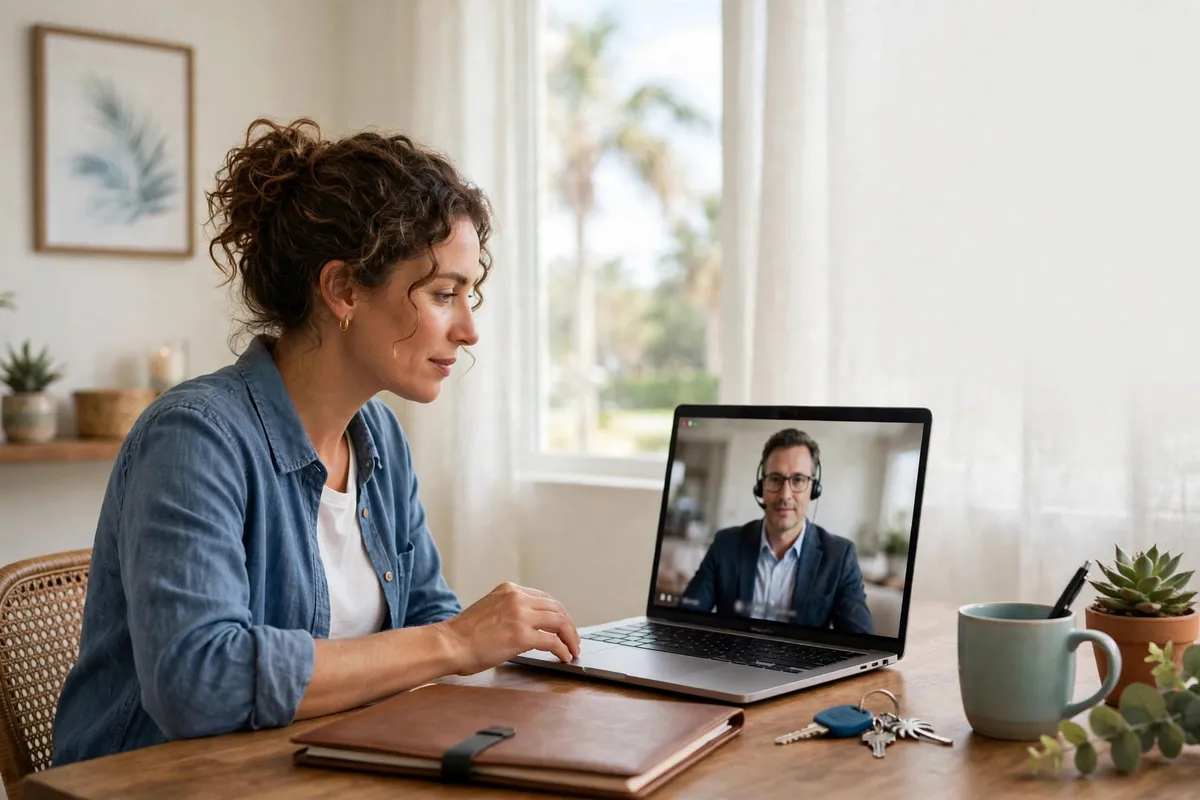
With Remote Online Notarization, often called RON, an eligible signer appears before a Florida notary by secure audio-video technology, verifies their identity online, and signs electronically during the session. For a signer who is traveling, working out of state, or caring for family in another city, it can keep a year-end closing moving without a flight back to Miami.
What to keep in mind: RON is never automatic. Your lender and title company must confirm that an online closing is acceptable for your specific transaction, and each document must be eligible. Ask early, and get that confirmation before you build your plans around signing online. If RON is not approved, a mobile or in-office signing is the fallback, which is another reason to decide while there is still time to switch.
Four Questions That Point to the Right Choice
1. Where will every signer be on signing day? If the answer is the same city, mobile or in-office is usually simple to arrange. If signers are in different places, ask about RON or a split signing right away.
2. What has your title company already approved? Their requirements come first. A method that worked for a friend's closing may not be approved for yours, because lenders, title companies, and transactions differ.
3. How much preparation does each signer need? A first-time buyer may be more comfortable with an in-person signing and time to ask about where to sign. A signer joining online needs time to test their device and find a quiet space.
4. How much room is left before your deadline? The closer you are to December 31, the more valuable a method with a backup plan becomes. Confirm your first choice, and know your second, before the final week arrives.
💡 Helpful reminder: A notary can explain each signing option and carry out the one your transaction allows, but the choice itself belongs to your lender and title company. Confirm the method with them before you schedule.
Frequently Asked Questions About Choosing a Signing Method
Can our signers use different methods for the same closing?
Sometimes, yes. This is called a split signing. One signer might sign with a mobile notary in Miami while another signs online from another state, or at a different time. Whether that is acceptable is entirely up to your title company and lender. They will say if split signings are permitted for your transaction and how the documents must be handled and returned. If you think you will need one, raise it as soon as you know a signer will be away, not when the package is ready.
Does online notarization work for every Florida closing?
No. Florida allows Remote Online Notarization, but that does not mean every lender, title company, or document accepts it. Some transactions require wet signatures on paper, and some lenders have their own policies about online signings. The only safe answer for your closing comes from your title company and lender, so ask them directly and early. Blue Ink can perform a remote signing where it is approved and the documents are eligible, and an in-person signing where it is not.
How far ahead should we choose a method?
As soon as your closing date is confirmed. The method decision and the notary booking belong together, because the method affects the appointment time, the location, and how your package is prepared. Choosing in November, or in the early part of December, leaves room to change methods if your title company does not approve your first choice. Choosing in the final week usually means taking whatever is still available.
📌 Key takeaway: The best signing method is the one your title company approves, your signers can actually attend, and you arranged before the year-end rush made every calendar in Miami fill up.
Plan the Signing Around Your Signers, Not the Other Way Around
A year-end closing already asks your family to work around the calendar. Your signing should not add to that. When you choose the method early, confirm it with your title company, and tell your notary where every signer will be, the appointment itself becomes simple: the right people, in the right format, at the right time.
Blue Ink Signing Solutions offers all three options across Miami and South Florida: mobile signings at your location, in-office appointments in Brickell, and Remote Online Notarization for eligible Florida transactions when the lender and title company approve it. Tell us your closing date and where your signers will be, and we will help you line up the option that fits your transaction.
Reserve your year-end signing while the choice is still yours to make:
Mobile appointments: blueink.miami/mobile-now
Remote Online Notarization (when approved by your title company and lender): blueink.miami/ron-now
In-office Brickell appointments: blueink.miami/office-now
