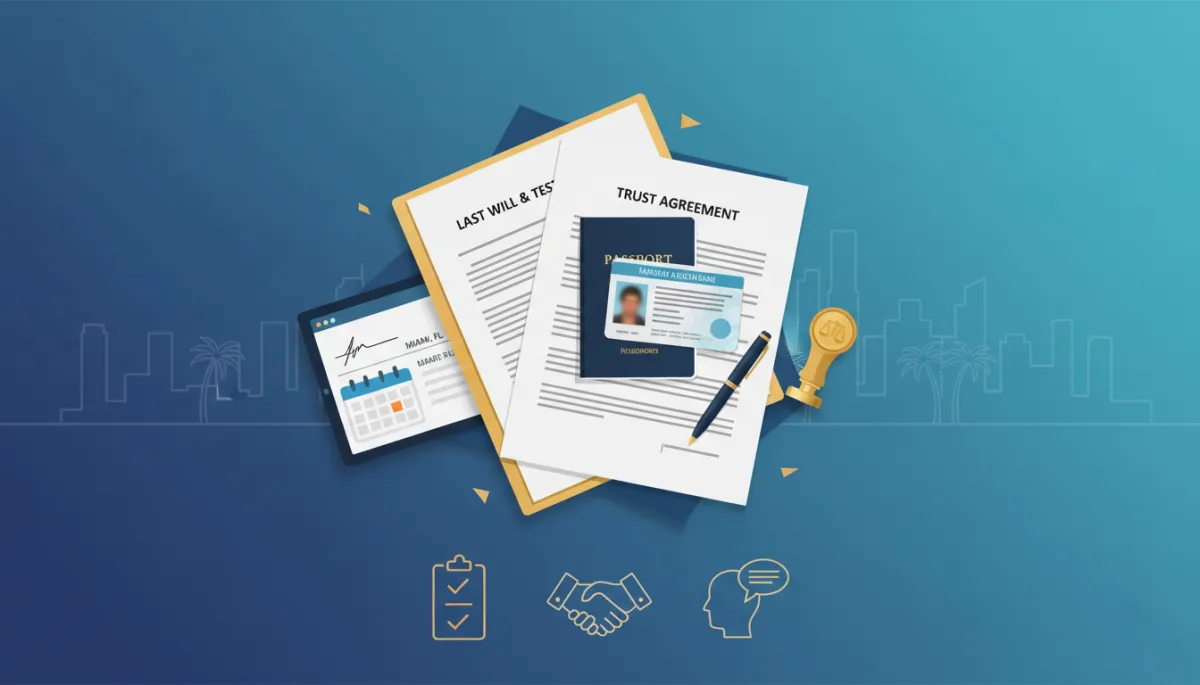
Estate Planning Documents: What to Bring to Your Notary Appointment
Estate Planning, Notarization, Miami Notary
Estate Planning Documents: What to Bring to Your Notary Appointment
When you are finalizing a will, trust, power of attorney, or healthcare directive, the notarization step is where everything becomes official. Arriving prepared saves time, reduces stress, and helps ensure your estate planning notarization is completed correctly the first time. Whether you are meeting at an office in Miami, using a mobile notary Miami service, or signing through remote online notarization (RON), knowing exactly what to bring is essential.
1. What to Have Ready Before Your Estate Planning Notary Appointment
A smooth estate planning notarization starts long before you sit down to sign. Before your appointment with Blue Ink Signing Solutions, make sure you have the following ready:
Final versions of all documents – Wills, trusts, durable powers of attorney, healthcare surrogates, living wills, HIPAA releases, and any related affidavits should be fully drafted and reviewed by your attorney before the notary arrives or your RON session begins. The notary cannot give legal advice or edit your documents for you.
Names and roles clearly confirmed – Double-check spelling and roles for all parties: testator, grantor, trustee, agents, guardians, and witnesses. Consistency between your ID and the documents helps avoid delays or corrections during signing.
Any special instructions from your attorney – If your law firm has specific signing instructions (such as signing order or initials on every page), have those ready to share with the notary so they can facilitate the process accurately.
In busy markets like Miami, where families often coordinate multiple signers and tight schedules, being prepared ensures your estate planning notary Miami appointment stays on time and on track.
2. Original Documents vs. Copies: What Your Notary Can and Cannot Do
One of the most common questions about documents needed for notarization is whether you must bring originals or if copies are acceptable. The answer depends on the type of notarization and the purpose of the document.
For signing estate planning documents – The notary is typically witnessing your signature on an original document. You will sign the original in front of the notary; copies can be made afterward for your records or your attorney. The notary’s seal and certificate are placed on the original.
For certified copies – In Florida, notaries can certify copies of certain documents that are not public records, as long as they compare the copy to the original. In that case, you must bring the original so the notary can properly certify the copy. Birth certificates, marriage licenses, and some court documents usually must be obtained directly from the issuing agency and cannot be certified by a notary.
When in doubt, bring your originals and any copies you plan to distribute. Your notary from Blue Ink Signing Solutions will clarify what can be notarized, what can be certified, and what must be obtained from another authority, all while staying within Florida law and not crossing into legal advice.
3. The Importance of Valid Government-Issued ID
Every notarization hinges on one core responsibility: verifying the identity of the signer. For estate planning documents, this step is especially critical because these documents can be challenged later if there is any question about who signed or whether they were properly identified. Florida notaries must rely on valid, government-issued photo identification, such as:
Florida or out-of-state driver’s license or ID card
U.S. passport or foreign passport stamped by U.S. immigration
U.S. military ID or other approved government ID with a photo and signature
The ID must be current or within the timeframe allowed by Florida law. Photos should be clear, names should reasonably match the documents, and the signer must appear in person (or on camera for RON). If your ID is expired or damaged, your appointment may need to be rescheduled, which can be disruptive when coordinating multiple signers or attorneys. Confirming valid ID in advance is one of the simplest ways to protect your estate planning notarization from future challenges.
4. Identifying All Signers and Their Roles
Many estate planning packages involve multiple signers: spouses, co-trustees, agents under power of attorney, or adult children named in healthcare documents. Before your appointment, list out:
Who is signing which document (for example, both spouses signing a joint trust, but only one spouse signing a separate power of attorney).
The capacity in which they are signing – as an individual, as trustee, as attorney-in-fact, or as a healthcare surrogate.
Share this information with your notary ahead of time so they can plan the signing order and confirm that everyone who needs to appear will be present with proper ID. For mobile notary Miami appointments, this is particularly important when the notary is traveling to a home, hospital, or assisted living facility where coordinating multiple people can be more complex.

Clear planning of signers and roles keeps complex estate signings efficient and accurate.
5. Witness Requirements for Estate Planning Documents
In Florida, many estate planning documents require witnesses in addition to a notary. For example, wills typically require two witnesses, and certain powers of attorney and healthcare directives also have witness requirements. Key points to understand include:
Witnesses generally must be adults who are present during the signing and able to observe the signer’s apparent willingness and capacity.
Certain documents may restrict who can serve as a witness (for example, it may be advisable that beneficiaries not act as witnesses for some estate planning instruments; your attorney can guide you on this).
Witnesses may also need to provide ID, especially for RON sessions, where the platform will capture their information.
💡 Pro Tip: Ask your notary service in advance whether they can coordinate witnesses for you. Blue Ink Signing Solutions frequently assists with witness coordination for estate planning notary Miami appointments, reducing the logistical burden on families and law firms.
6. Procedures When Multiple Documents Are Involved
Estate planning signings rarely involve just one document. A typical signing package might include a will, revocable trust, pour-over will, durable power of attorney, healthcare surrogate designation, living will, and several related affidavits or acknowledgments. To keep everything organized:
Group documents by signer and type. For example, place all documents requiring both spouses together, then any documents for each spouse individually. This helps the notary guide you through the signing in a logical order.
Flag pages that require notarization or witnessing. Your attorney may mark signature pages with tabs. The notary will still review each document, but tabs make it easier to ensure nothing is missed.
Allow extra time. Multiple documents mean multiple notarial certificates and journal entries. Building in a comfortable time window helps everyone stay focused and calm, especially when the documents carry significant emotional weight.
At Blue Ink Signing Solutions, our notaries are trained to manage complex signing packages efficiently while maintaining accuracy and compliance, whether the appointment is in-office, mobile, or conducted online.
7. Preparing for a Mobile or Remote Online Notarization (RON) Appointment
Mobile Notary Appointments in Miami
Mobile notary Miami services are ideal when clients prefer to sign at home, in a law office, hospital, or senior living facility. To prepare for a mobile estate planning notarization:
Ensure there is a clean, flat surface with enough room for all documents and signers.
Minimize distractions so signers can focus and the notary can clearly observe the signing.
Confirm parking or building access details with your notary in advance to avoid delays.
Remote Online Notarization (RON) for Estate Planning
Florida allows many estate planning documents to be notarized online using approved RON platforms. When booking a remote session with Blue Ink Signing Solutions, you will receive instructions for uploading your documents and verifying identity through the platform. To prepare:
Test your internet connection, camera, and microphone ahead of time on the device you will use.
Have your physical ID ready to present on camera, even if the platform also uses knowledge-based authentication or credential analysis.
Choose a quiet, well-lit space where your face and ID will be clearly visible and where you can focus on the documents being presented on screen.
Whether you choose mobile or RON, a few minutes of preparation ensures your estate planning notary Miami appointment proceeds smoothly and meets all legal and technical requirements.
8. Why Sending Documents in Advance Makes Your Signing Smoother
One of the most effective ways to streamline your appointment is to send your documents to the notary service in advance. Many clients are surprised at how much smoother the experience is when their estate planning package is reviewed for logistical issues ahead of time. When you share documents with Blue Ink Signing Solutions before the meeting (securely and in coordination with your attorney), we can:
Confirm which pages require notarization and which only need witnesses or initials, so nothing is overlooked during the appointment.
Estimate the time needed for the signing and recommend the appropriate appointment length, especially important for large trust packages or multi-party signings.
Identify any potential issues with notarial certificates or witness blocks that may need to be clarified by your attorney before the appointment.
For RON sessions, sending documents in advance is essential, as the documents must be uploaded, tagged, and prepared inside the platform. For mobile appointments, advance review reduces the chance of last-minute confusion or missing pages. In all cases, it protects your time and supports a calm, professional signing experience.
Partnering with a Professional Estate Planning Notary in Miami
Estate planning often marks major life transitions—marriage, children, retirement, or caring for aging parents. During these moments, you deserve a notarization process that is efficient, compliant, and handled with empathy. Blue Ink Signing Solutions works closely with law firms, title companies, healthcare facilities, and individual clients to provide reliable estate planning notarization across Florida, including comprehensive mobile notary Miami and remote online options.
By arriving with the right documents, valid ID, clearly identified signers and witnesses, and by sharing your documents in advance, you help ensure that your signing session is focused, organized, and respectful of everyone’s time and emotions. Our team handles the logistics and compliance details so you can focus on the decisions that matter most for your family and future.
Ready to schedule? Book your mobile, remote online, or in-office notarization appointment with Blue Ink Signing Solutions today to experience professional, seamless, and compliant document execution support:
Mobile Appointments: blueink.miami/book-mobile
Remote Online Notarization: blueink.miami/book-ron
In-Office Appointments: blueink.miami/book-office
