Apostille Guide for Dual Citizenship in Florida
Apostille, Dual Citizenship, Florida, Miami
How to Get an Apostille for Dual Citizenship in Florida (2026 Guide)
Many dual citizenship applications require official U.S. documents to be authenticated through the apostille process before they will be accepted by foreign governments. For Florida residents in Miami-Dade, Broward, Palm Beach, and across the state, this often means obtaining apostilles for birth, marriage, death, and court records that will be submitted overseas.
Countries such as Italy, Spain, Colombia, Argentina, the Dominican Republic, and many others that participate in the Hague Apostille Convention typically require apostilled records for citizenship by descent, citizenship through parents or grandparents, and other nationality applications. This guide from Blue Ink Signing Solutions, based in Miami, Florida, explains how Florida residents can obtain apostilles for dual citizenship in 2026 and how professional assistance can simplify the process.
What Is an Apostille?
An apostille is an official certificate issued under the 1961 Hague Apostille Convention that confirms the authenticity of a public document for use in another country. In Florida, the apostille is attached by the Florida Secretary of State to verify the signature, seal, and official capacity of the person who signed the document, not the truth of the document’s contents.
Countries require apostilles so they can trust that a foreign birth certificate, marriage record, court order, or notarized document really was issued or notarized by the proper authority. Instead of sending documents through an embassy for “legalization,” countries that are members of the Hague Apostille Convention accept this standardized apostille certificate as proof of authenticity.
For example, if you were born in Miami and are applying for Italian citizenship by descent, the Italian consulate will usually require your Florida birth certificate with an apostille. The apostille shows Italian authorities that the birth certificate was issued by the State of Florida and that the state official’s signature is genuine and properly recorded with the Florida Department of State.
Why Dual Citizenship Applications Often Require Apostilles
Dual citizenship applications almost always involve proving your identity and your family relationships across borders. When you apply for citizenship by descent, through parents, or through grandparents, the foreign government must be confident that every record you submit is authentic and has not been altered. An apostille provides that assurance for documents issued in Florida.
Citizenship by Descent, Parents, or Grandparents
Many countries, including Italy and Spain, allow people to claim citizenship based on ancestry. These programs often require a chain of documents showing each generation:
Your own birth certificate, proving your identity and parentage
Parents’ or grandparents’ birth certificates, showing they were citizens or born in the foreign country
Marriage certificates linking each generation
Because these documents were issued in different countries and at different times, governments rely on apostilles to verify that each record is a genuine public document from its country of origin. Without apostilles, consulates and foreign ministries would need to individually verify every signature and seal, which is impractical and slow.
International Legal Verification Requirements
Foreign governments require authenticated records for several reasons:
To prevent fraud and identity theft in citizenship and passport applications
To ensure that name changes, adoptions, and divorces are legally valid
To comply with international agreements such as the Hague Apostille Convention
For instance, Italy and Spain both typically require apostilled U.S. vital records for citizenship applications. An applicant in Miami seeking Italian citizenship by descent might need apostilled Florida birth certificates, marriage certificates, and a divorce decree to prove a complete, legally valid family line. Similarly, an applicant for Spanish citizenship through grandparents may need apostilled U.S. records showing each generation’s birth and marriage details.
Common Documents Required for Dual Citizenship Applications
Every country sets its own requirements, but most dual citizenship cases involving Florida residents use a familiar set of records. These often need to be certified and then apostilled by the Florida Department of State in Tallahassee.3
Birth Certificates
A Florida birth certificate apostille is one of the most common requirements for dual citizenship. It proves your identity, date and place of birth, and parentage. For citizenship by descent, it also shows your connection to a foreign-born parent or grandparent. Florida birth certificates must be certified copies issued by the Florida Bureau of Vital Statistics or a local county health department; “souvenir” or hospital certificates cannot be apostilled.3
Marriage Certificates
A Florida marriage certificate apostille confirms the legal relationship between spouses and helps foreign authorities trace family lines. For example, when applying for Italian citizenship, you may need apostilled marriage certificates for your parents or grandparents to link each generation. These records usually come from the Clerk of Court in the county where the marriage license was issued and must be certified before the apostille can be attached.
Death Certificates
Apostilled death certificates may be required when an ancestor in the citizenship line has passed away. They help confirm identity, marital status, and sometimes nationality at the time of death. For example, Spain or Italy may request apostilled death certificates for deceased grandparents to complete the family record set.
Divorce Decrees
Divorce records become important when a parent or grandparent remarried, or when name changes occurred. A court-certified divorce decree from a Florida Clerk of Court can be apostilled to show that a previous marriage legally ended, which may affect the legitimacy of later marriages and children under foreign law. Because these documents are certified by the court, the apostille fee is slightly higher in Florida ($20 per document, including a certificate from the Clerk).1
Court Records and Name Change Orders
Court judgments, name change orders, and other judicial records may be required when names differ significantly across documents. For example, if your grandmother’s maiden name, married name, and later legal name are all different, a Florida court order or divorce judgment may need to be apostilled to explain those changes for the foreign authority.
Adoption Records
Adoption can significantly affect citizenship eligibility. Some countries treat adopted children differently from biological children for citizenship by descent. Apostilled adoption decrees, amended birth certificates, and related court orders may be required to show the legal relationship between the adoptive parent and child. These records must be certified by the court or issuing authority before apostille.
Notarized Affidavits and Supporting Documents
Some citizenship applications allow or require sworn statements—such as affidavits explaining name discrepancies, missing records, or family circumstances. In Florida, these documents must be properly notarized by a Florida notary public before they can receive an apostille. Blue Ink Signing Solutions regularly notarizes affidavits and other supporting documents for international use.
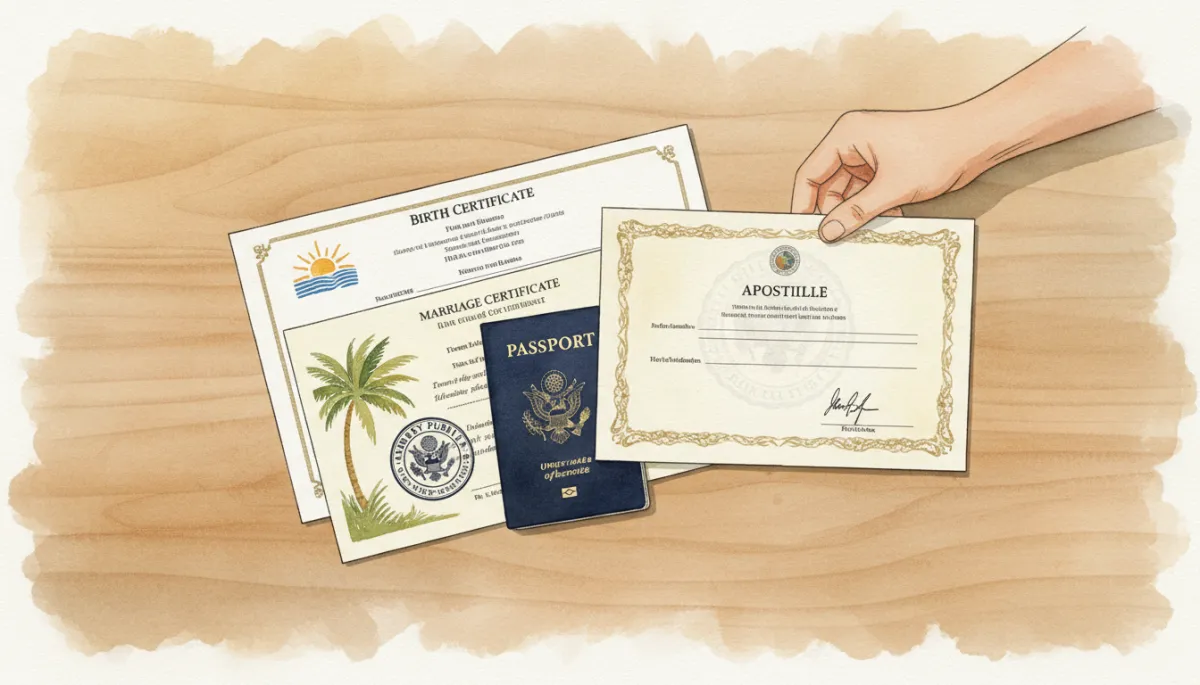
Organizing certified Florida records early helps prevent delays in dual citizenship timelines.
How Our Apostille Service Works
Step 1: Submit Your Document
Send us your document or schedule a mobile pickup. We'll review your paperwork, confirm apostille eligibility, and ensure everything is prepared correctly before submission.
Step 2: We Handle the Apostille Process
Our team manages the apostille submission process with the Florida Secretary of State, including all required forms, state fees, and document tracking.
Step 3: Receive Your Apostilled Documents
Once completed, we'll securely return your apostilled documents by mail or arrange local delivery. Mobile delivery options are available throughout South Florida.
Apostilles for Italian Citizenship Applications
Italian citizenship by descent (often called jure sanguinis) is one of the most common pathways for Florida residents seeking a second passport. While every case is unique, most Italian consulates require a detailed set of U.S. records, many of which must be apostilled by the state where they were issued. Blue Ink Signing Solutions frequently assists Miami-area clients with the Florida side of this process.
Typical Records for Italian Citizenship by Descent
Italian citizenship applications often involve:
Your Florida birth certificate, apostilled and later translated into Italian
Birth, marriage, and death certificates for each ancestor in the Italian line, apostilled in the state where they were issued
Divorce decrees or name change orders, if applicable, with apostilles
Florida documents in this set, such as a grandparent’s Miami birth certificate or a Broward County marriage certificate, must be apostilled by the Florida Department of State. Documents from other U.S. states or from Italy itself follow their own local procedures.
Document Authentication and Consular Expectations
Italian consulates are often strict about:
Using long-form vital records that show full details of parents and places of birth
Ensuring dates, names, and spellings match across all documents
Requiring apostilles on every U.S. public document in the application
While Blue Ink Signing Solutions does not provide legal advice or determine eligibility, we help clients ensure that their Florida documents are correctly notarized, certified, and apostilled so they meet typical Italian consular standards. This can significantly reduce the risk of rejection or requests for additional documentation.
Apostilles for Spanish Citizenship Applications
Spain offers several pathways to citizenship, including citizenship by descent, citizenship for descendants of Spanish nationals, and naturalization routes for long-term residents. Many South Florida residents with Spanish roots must gather U.S. records to prove identity and family history, and these records often require apostilles.
Common Documentation for Spanish Citizenship
Spanish authorities may request:
Your apostilled Florida birth certificate, demonstrating your identity and parentage
Apostilled marriage certificates, especially when surnames change or when documenting family ties to a Spanish citizen
Apostilled court records, such as name change orders or adoption decrees, if relevant
Because Spain is also a member of the Hague Apostille Convention, an apostille from the Florida Secretary of State is usually sufficient to authenticate Florida public documents for use in Spanish citizenship applications.2 However, Spain often requires certified translations into Spanish as well, which are separate from the apostille itself.
Countries That Commonly Require Apostilled Documents
Many Florida residents pursue dual citizenship or other legal processes in countries across Europe and Latin America. Here are some common destinations where apostilled Florida documents are frequently required:
Italy: Often for citizenship by descent, requiring apostilled birth, marriage, death, and sometimes naturalization records for multiple generations.
Spain: For citizenship, residency, or marriage registration, commonly needing apostilled birth and marriage certificates and background checks.
Colombia: For dual citizenship, recognition of civil status, or marriage in Colombia, Florida birth and marriage certificates often require apostilles and Spanish translations.
Mexico: Frequently for marriage, residency, or property transactions, requiring apostilled U.S. vital records and notarized powers of attorney.
Argentina and Brazil: For citizenship recognition, marriage, or inheritance matters, these countries typically ask for apostilled birth and marriage certificates and sometimes court judgments or powers of attorney.
Dominican Republic: Especially relevant in South Florida, where many families have Dominican ties. Apostilled U.S. birth, marriage, and divorce records are commonly required for citizenship, marriage, or property procedures.
Chile and Peru: These countries often require apostilled Florida documents for residency, marriage registration, and recognition of foreign civil status or academic degrees.
In each case, the apostille serves the same function: it tells the foreign government that the Florida document is genuine and that the official who signed or sealed it is properly authorized. Requirements can still vary, so it is wise to confirm details with the relevant consulate or embassy before starting the process.
Common Mistakes That Delay the Apostille Process
Dual citizenship timelines are often tight, especially when consulate appointments are scheduled months in advance. Avoiding common errors can save significant time and frustration for Florida residents.
Using Unofficial or Photocopy Versions
The Florida Department of State will not issue an apostille on photocopies, hospital keepsake certificates, or documents printed from online portals unless they are properly certified or notarized. Always obtain an official certified copy from the issuing authority before submitting for apostille.3
Submitting Outdated Records
Some consulates, especially for Italian and Spanish citizenship, require records issued within a recent timeframe (often within one year). Using older Florida certificates can lead to requests for updated copies, causing avoidable delays. When in doubt, order fresh certified copies before apostille.
Incorrect Notarization or Missing Notary Details
For notarized documents, Florida law requires specific wording, a clear notary seal, the notary’s signature, and the correct date and venue. Incomplete or incorrect notarizations cannot be apostilled. Blue Ink Signing Solutions provides mobile notary and remote online notarization services to ensure documents meet Florida standards before they are sent to Tallahassee.
Missing Supporting Documentation or Fees
Forgetting to include the Apostille Request Form, incorrect payment, or omitting a return envelope can cause the Florida Department of State to place your request on hold or return it unprocessed. Carefully following the state’s checklist—or working with a professional service—reduces these risks.1
Translation Mistakes and Wrong Sequence
Many applicants are unsure whether to translate documents first or obtain the apostille first. In most cases, the apostille is attached to the original English document, and the translation accompanies it. Translating too early, or translating a document that later must be reissued, can waste time and money. Always verify the sequence required by your destination country or consulate.
Waiting Until the Last Minute
Because apostille processing times, consulate appointments, and translation schedules can all fluctuate, waiting until just before your appointment is risky. Starting early allows time to correct errors, replace documents, or add missing records without jeopardizing your dual citizenship timeline. Blue Ink Signing Solutions can help you map out a realistic schedule based on your goals and deadlines.
Do You Need Certified Translations?
Many countries require documents to be submitted in their official language. For dual citizenship applications in Italy, Spain, Colombia, and other Spanish- or Italian-speaking countries, this usually means providing certified translations of your Florida documents in addition to the apostille.
It is important to understand that:
An apostille authenticates the signature and seal on a public document for international use; it does not translate the document or confirm its content.2
A certified translation is prepared by a qualified translator who attests that the translation is accurate and complete.
Some consulates want the apostille to be attached to the original English document, with the translation referencing both the document and the apostille. Others may have more specific requirements. Blue Ink Signing Solutions can coordinate with translation providers and help you determine the correct order of steps so your Florida apostille and translations work together smoothly for your citizenship application.
Why Florida Residents Choose Blue Ink Signing Solutions
Blue Ink Signing Solutions is a Miami-based provider serving clients in Miami-Dade, Broward, Palm Beach, and throughout Florida. For individuals and families pursuing dual citizenship with Italy, Spain, Colombia, the Dominican Republic, and other countries, working with an experienced apostille support provider can make a complex process more manageable.
Apostille Expertise and Personalized Guidance
Blue Ink focuses on document preparation for international use. We help clients:
Identify which Florida documents typically need apostilles for different citizenship pathways
Confirm whether documents require notarization, certification, or both before apostille
Avoid errors that can cause the Florida Department of State to reject or delay a request
Experience With International Documentation
Blue Ink works regularly with clients seeking Italian, Spanish, Colombian, and Dominican Republic citizenship, as well as other immigration and international matters. This experience allows us to anticipate common consular expectations and help clients assemble document packages that are organized, complete, and ready for submission.
Convenient Mobile, Remote, and Local Service
For busy professionals and families in South Florida, traveling to multiple offices can be challenging. Blue Ink offers:
Mobile notary services that come to your home, office, or another convenient location in Miami-Dade, Broward, and Palm Beach Counties
Remote online notarization (RON) for eligible documents, allowing you to complete notarizations securely from anywhere in Florida
Support with estate planning notarization and other legal documents that may later require apostilles for use abroad
South Florida Knowledge and Time-Sensitive Support
Because Blue Ink Signing Solutions is based in Miami, we understand the needs of South Florida’s international community. Whether you are coordinating with the Italian consulate in Miami, the Spanish consulate, or a Latin American consulate elsewhere, we can help you:
Prioritize which documents to obtain and apostille first based on upcoming appointments
Coordinate notarizations and document pickups at times that work with your schedule
Address last-minute document needs whenever possible, within the limits of state processing times
Conclusion: Prepare Your Florida Apostilles the Right Way
Apostilles play a critical role in dual citizenship applications. They allow foreign governments to trust that your Florida birth certificates, marriage records, court orders, and notarized documents are authentic. For Italian, Spanish, Colombian, Dominican Republic, and other citizenship pathways, properly apostilled records are often the difference between a smooth application and months of delay.
By understanding which documents you need, obtaining the right certified copies, following the Florida Department of State’s apostille procedures, and coordinating translations when required, you can present a complete, professional application package to your consulate or immigration authority. Starting early and avoiding common mistakes—such as unofficial copies, incorrect notarizations, or missing fees—will help keep your dual citizenship plans on track.
If you are in Miami-Dade, Broward, Palm Beach, or anywhere in Florida and are preparing for Italian, Spanish, Colombian, Dominican Republic, or other dual citizenship applications, Blue Ink Signing Solutions is ready to help you navigate the apostille process with confidence. Contact Blue Ink today to schedule mobile or remote notarization, receive guidance on Florida apostille requirements, and take the next step toward your dual citizenship goals.
